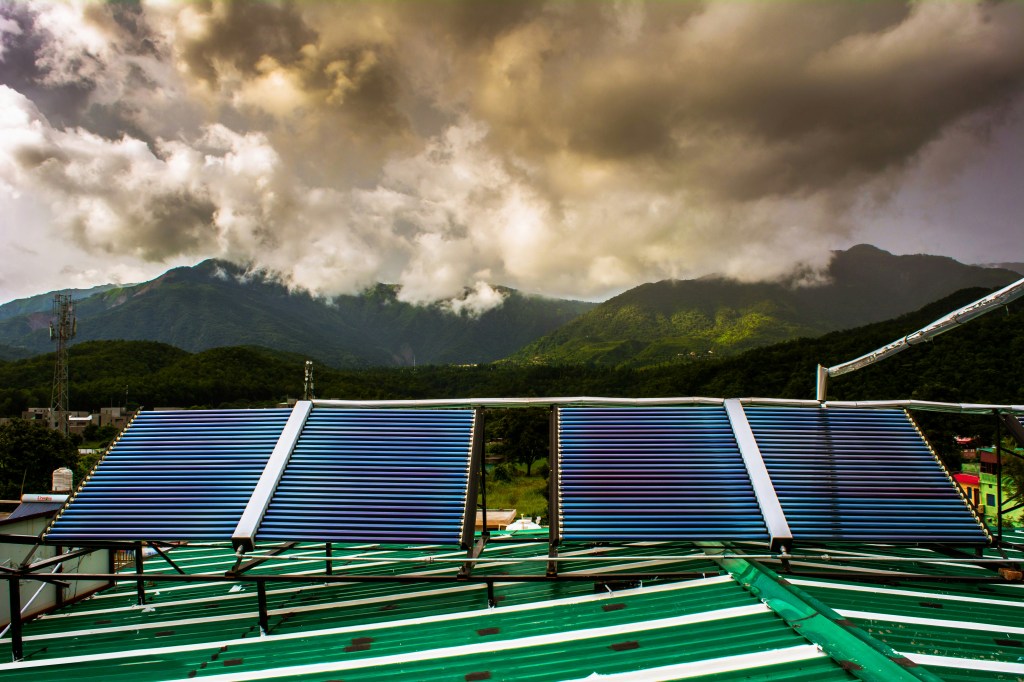
Photo From KUSHAGRA DHALL on Unsplash
From Water to Watt: The Rise of Floating Solar in Sarawak
The global pursuit of renewable energy has accelerated dramatically in recent years, driven under urgent imperative of climate mitigation and energy security. Southeast Asia, a region traditionally dependent on fossil fuels, is now emerging as a dynamic region for clean energy development. Malaysia, with its abundant hydroelectric and solar installation capacity, has taken a leading role in this regional initiative. Among the most ambitious initiatives is the Batang Ai Floating Solar Project in Sarawak, an effort that integrates floating solar photovoltaic (FPV) technology with hydro electric turbine production, symbolizing a shift toward alternating power sources in sustainable energy (2024).
Floating solar panel arrays on water is the deployment of photovoltaic arrays on the surface of lakes, reservoirs, and hydroelectric dams. Representing an elegant solution to the challenges of land scarcity and environmental conservation. The technology offers such benefits: optimizing existing water surfaces for power generation while simultaneously reducing water evaporation and improving the efficiency of solar modules through natural cooling. Sarawak’s decision to deploy FPV at Batang Ai reflects a strategic vision to harness water and sunlight within a single, integrated energy landscape.
The Batang Ai Floating Solar Project
The Batang Ai Floating Solar Photovoltaic Project, with a planned capacity of 50 megawatts (MW), stands as Malaysia’s largest floating solar facility indevelopment (Trina Solar Co., Ltd., 2022). Situated atop the Batang Ai Hydroelectric Dam Reservoir in the Sarawak, the project is spearheaded by Sarawak Energy Berhad, in partnership with the Chinese renewable energy company Trina Solar. As of June 2024, the project had reached 35% completion, with commissioning targeted for October 2024 (DayakDaily, 2024). Installation covers a portion of the reservoir’s calm surface, utilizing floating platforms composed of high-density polyethylene designed to withstand tropical weather conditions. Solar panels mounted atop these platforms are tethered securely to prevent drift, while underwater cables connect the arrays to onshore substations. This energy mix infrastructure allows the Floating PV system to produce in tandem under the stable conditions of the existing hydroelectric plant minimizing energy loss and maximizing reliability!
The Premier of Sarawak, Tan Sri Abang Johari Openg, has emphasized the symbolic and strategic significance of this development, making remarks of a new milestone in Malaysia’s outward image shift toward renewable primacy. In his address in October 2025, he declared that the project would not only enhance Sarawak’s clean energy capacity but also “set out to become Malaysia’s largest solar power facility,” underscoring the state’s ambition to lead Southeast Asia in integrated renewable energy systems (Malay Mail, 2025).
Technological Principles of Floating Solar Photovoltaics (FPV)
Floating solar, though conceptually simple, represents a major leap in the evolution of photovoltaic engineering. Traditional ground-mounted solar farms face constraints of land availability, environmental degradation, and high surface temperatures that can reduce energy conversion efficiency. FPV systems, by contrast, are installed along a waters surfaces, where evaporative cooling takes place allowing optimal panel temperatures and enhances output efficiency by 10–15% compared to land-based installations.
At Batang Ai, this efficiency is further supported by the region’s stable hydrological conditions and moderate solar irradiance. The panels are positioned to minimize shading while optimizing seasonality for year-round sunlight exposure.
Floated PV arrays serve an unexpected ecological purpose. By shading portions of the reservoir, they reduce evaporation rates, helping to preserve freshwater sources. A critical advantage in tropical climates. Moreover, the co-location with hydroelectric infrastructure allows both systems to complement each other: solar panels supply power during daylight hours, while the dam’s turbines stabilize output at night or during cloudy conditions. This synergy exemplifies a model of “hydro-solar complementarity”, an approach increasingly studied as a cornerstone of sustainable grid integration in developing economies.
Hybridization with Green Hydrogen Production
Perhaps the most forward-looking dimension of the Batang Ai project is its integration with green hydrogen generation. According to Hydrogen APAC (2024), Sarawak has embarked on an ambitious program to become a regional hydrogen hub, leveraging its renewable energy assets to produce hydrogen through electrolysis a process that splits water molecules into hydrogen and oxygen using electricity derived from clean sources.
By coupling floating solar with hydroelectric, the Batang Ai initiative creates a continuous energy cycle: solar energy powers homes during the day, and hydroelectric power provides a stabilizing continual efficiency.
Technical and logistical challenges doremain. High production costs, and the need for robust infrastructure pose obstacles to global scalability.
Despite these hurdles, Batang Ai’s integrated approach marks a pioneering moment for renewables in the Asia-Pacific region. It illustrates how emerging economies can overcome fossil-energy uses into sustainable systems tailored to their geographic and economic conditions.
In essence, the Batang Ai Floating Solar-Hydrogen Initiative represents not only Malaysia’s entry into the global race for clean energy leadership but also an advance for holistic energy architecture that aligns with the world’s shift toward decarbonization, energy independence, and ecological harmony.

Photo from Kiran Kesarapu on Unsplash
Through Sarawak Energy, the state has developed multiple hydroelectric power plants that collectively generate more than 70% of the nation’s electricity. However, the integration of floating solar systems on existing hydro reservoirs marks a significant evolution attempt of conversion from single-source hydropower generation. (MIDA, 2024).
According to MIDA (2024), the state plans to replicate Batang Ai’s floating solar concept across other hydroelectric facilities, including the Bakun and Murum dams. These projects are expected to form part of a larger renewable cluster, integrating energy storage with smart grid systems. This policy trajectory aligns with Malaysia’s broader commitment under the National Energy Conversion Roadmap (NETR), which targets a 70% renewable energy mix by 2050.
Furthermore, Sarawak’s government has adopted an export-oriented perspective, envisioning the production of hydrogen as a green energy commodity for international markets. Hydrogen APAC (2024) highlights that Japan and South Korea two of Asia’s most energy-dependent economies have already expressed formal interest in importing Sarawak’s green hydrogen once production scales up. Such cross-border collaboration demonstrates that Batang Ai’s role transcends local utility; it serves as a catalyst for regional energy diplomacy.
Environmental and Societal Sustainability
Beyond economics and technology, the Batang Ai initiative also addresses the environmental sustainability of renewable energy expansion. Floating solar technology has been praised for its relatively low ecological footprint compared to land-based alternatives, as it does not require deforestation or land conversion. The use of existing hydro reservoirs eliminates the need for new infrastructure, thereby minimizing habitat disruption (Trina Solar Co., Ltd., 2022).
However, sustainability requires balance. Continuous monitoring of aquatic ecosystems is necessary to assess potential effects on water quality, light penetration, and fish habitats. Sarawak Energy Berhad, in partnership with Trina Solar, has implemented a series of ecological impact assessments to ensure that FPV installations coexist harmoniously with the reservoir’s biodiversity. DayakDaily (2024) reports that project engineers have integrated floating arrays in modular clusters, allowing water circulation and reducing localized thermal effects.
From a societal standpoint, Batang Ai’s development model also emphasizes inclusive economic participation. Local communities are involved in support services, logistics, and maintenance, providing new employment opportunities in rural areas. The project thus embodies a dual sustainability principle environmental and social by integrating clean technology with community empowerment.
The Premier of Sarawak underscored this in 2025, stating that “renewable progress must not only generate electricity but also inspire regionally.” This perspective reflects a broader redefinition of sustainability that combines technological innovation with social justice and energy democratization (Malay Mail, 2025).
Hydro-floating PV as the Next Frontier
The most conversive aspect of the Batang Ai initiative lies in its connection to hydroelectric production, marking a paradigm shift in Southeast Asia’s approach to energy security. Hydrogen APAC (2024) identifies Sarawak as one of the first national entities in the region to implement an integrated hydrogen roadmap, with Batang Ai acting as both a testing ground for power sources envisioning.
Economic and Global Significance
Globally, Batang Ai represents a case study in climate-aligned development. It demonstrates that tropical nations can pursue energy independence while contributing to global decarbonization efforts. As the world grapples with balancing sustainability and growth, Sarawak’s model underscores that renewable expansion need not come at the expense of ecology or equity instead, both can advance in tandem.
References
DayakDaily. (2024, June 20). Malaysia’s largest hybrid floating solar farm in Batang Ai 35% complete, targeting October 2024 commission.
https://dayakdaily.com/malaysias-largest-hybrid-floating-solar-farm-in-batang-ai-35pct-complete-targeting-october-2024/
Hydrogen APAC. (2024). Shaping Sarawak’s future: Leading the charge in green hydrogen development.
https://hydrogenapac.com/wp-content/uploads/2024/07/240605_1.pdf
Malay Mail. (2025, October 6). Sarawak premier: Batang Ai sets out to become Malaysia’s largest solar power facility.
https://www.malaymail.com/news/malaysia/2025/10/06/sarawak-premier-batang-ai-sets-out-to-become-malaysias-largest-solar-power-facility/193661
MIDA. (2024, November 25). Sarawak targets more floating solar for its hydroelectric dams.
https://www.mida.gov.my/mida-news/sarawak-targets-more-floating-solar-for-its-hydroelectric-dams/
Trina Solar Co., Ltd. (2022, July 12). Trina Solar secures 50 MW floating solar photovoltaic (FPV) project in Sarawak, Malaysia.
https://www.trinasolar.com/en-mea/resources/newsroom/wed-07132022-1446
 Gratify Gravity