Background and Early History
Biosphere 2 is a massive research facility designed as a closed ecological system, covering approximately 3.14 acres (1.27 hectares). This ambitious project was constructed between 1987 and 1991, funded by billionaire Ed Bass and conceived by the visionary John P. Allenan engineer, writer, and founder of the Institute of Ecotechnics. The original idea stemmed from the desire to create a man-made environment capable of sustaining life independently as a “miniature ecosystem” replicating Earth’s natural systems (Biosphere 1).
The concept was not only intended for terrestrial research but also envisioned as a prototype research facility for future human expansions in outer space or on other planets, such as Mars. Biosphere 2 was designed to contain a variety of miniature biomes, including a rainforest, desert, artificial ocean, mangrove wetlands, and agricultural land to provide food for its inhabitants. All these systems were integrated into a completely sealed structure, entirely isolated from the outside world, with the goal of determining whether humans, plants, and animals could survive without any material exchange with the external environment.
The construction of the facility involved hundreds of workers, scientists, and engineers who collaborated to integrate climate-control technologies, water recycling systems, and automated air-quality management. The uniqueness of Biosphere 2 lay in its attempt to maintain an extraordinarily complex ecological balance, where every elementfrom oxygen levels to insect populationshad to be managed with extreme precision.
For its founders, the project represented a fusion of science, art, and a vision of the future. However, for some observers, the idea appeared to be an overly ambitious and high-risk experiment. Nevertheless, the concept of building a “mini-Earth” captured public and media attention worldwide, sparking broad debates about the possibilities and limitations of human technology in controlling closed ecosystems.

Photo from Celine Ylmz on Unsplash
Closed Experiment: The 1991–1994 Mission
In 1991, eight individualslater famously referred to as the “Biospherians”sealed themselves inside the colossal glass-and-steel dome of Biosphere 2, committing to live in complete isolation from the outside world for a planned duration of two years. This bold experiment aimed to test whether a fully self-sustaining, closed ecological system could truly support human life without any material exchange with Earth’s natural environment. However, as the months passed, the mission encountered a series of significant challenges: oxygen levels inside the structure steadily dropped to dangerously low levels, interpersonal tensions among the crew members intensified into notable conflicts, and various plant and animal species within the artificial biomes either failed to thrive or died altogether, threatening the balance of the entire ecosystem.
The Guardian, in its retrospective coverage, offered a sharp and somewhat skeptical portrayal of the project, underscoring the dramatic difficulties and unintended consequences that emerged during the mission. Yet, more recently, an alternative and more optimistic interpretation has been presented through the documentary Spaceship Earth. Wired highlighted how this film repositions the narrative of Biosphere 2 not as a total failure, but rather as an ambitious, imaginative, and daring scientific endeavor whose lessons remain highly relevant for understanding sustainability, resilience, and the human capacity to adapt in extreme conditions. This reframing invites a reconsideration of the project, encouraging viewers to see it not merely through the lens of its shortcomings, but also as a pioneering attempt to push the boundaries of ecological science and human exploration.
While Biosphere 2 exposed the inherent difficulties of sustaining a fully closed ecological system, real-world models of resource-efficient, technology-driven sustainability can be observed on a national scale. One of the most striking examples is the Netherlands, which has increasingly positioned itself as a global agricultural powerhouse despite its relatively modest geographical size, ranking as the world’s third-largest exporter of agricultural products behind only the United States and Braziltwo countries that possess more than 200 times its landmass. This remarkable achievement is not the result of natural abundance alone, but rather the outcome of a deliberate national strategy introduced over two decades ago, encapsulated in the slogan “produce twice as much food using half as many resources.” … [paragraf Belanda berlanjut seperti yang sudah kamu tulis].
Modern Innovation: Space Analog for the Moon & Mars (SAM)
Since 2007, the facility has been managed by the University of Arizona. Today, Biosphere 2 also serves as the home of the Space Analog for the Moon & Mars (SAM), a fully enclosed, high-pressure habitat built upon the foundation of the original 1987 modules.
Studies on closed ecological systems have demonstrated that the creation of an artificial environment capable of sustaining human life is not merely a technical task, but rather a multidisciplinary challenge requiring highly precise architectural design, layered ecosystem management, and a profound understanding of the biological and social interactions within it. The experience of Biosphere 2 highlights that gas fluctuations, the failure of several species to adapt to artificial conditions, and the complex social dynamics of its inhabitants were key factors significantly influencing the system’s sustainability. The inability to maintain oxygen stability and the resulting ecological imbalance provided critical lessons on the limitations of technology, while also opening pathways for methodological improvements.
Subsequently, smaller-scale experiments in the Laboratory Biosphere revealed that modular design, the integration of productive agriculture based on controlled ecology, and the use of automated climate systems regulated by advanced sensors could enhance long-term stability while reducing the risks of ecosystem failure. This approach enabled more measurable investigations of energy dynamics, nutrient recycling, and organism interactions that were difficult to capture at a larger scale.
Drawing from these experiences, Alling et al. (2005) emphasized that the Mars On Earth Project was specifically designed to adapt the critical lessons learned from Biosphere 2 and the Laboratory Biosphere, thereby enabling the development of more efficient, sustainable, and resilient closed habitats for space missions. This research not only contributes to the advancement of technical protocols and supporting infrastructure for crewed space exploration, but also broadens perspectives on the potential colonization of Mars and other planets, while enriching global discourse on the sustainability of human life beyond Earth.
The first mission, Inclusion I, was conducted in April 2023, lasting six days and involving a crew of four participants. Upon their exit, they were welcomed by Linda Leigh, one of the original “Biospherians,” who personally greeted them through the habitat’s airlock.
The purpose of SAM is to provide a highly realistic simulation of how humans might live and work in extraterrestrial environments such as the Moon or Mars. This habitat, covering approximately 1,200 square feet, includes sleeping quarters, a kitchen, a hydroponic garden for food production, and an advanced atmospheric pressure control system. Beyond serving as a training and research platform, SAM also functions as a testing ground for sustainable life-support technologies, environmental monitoring systems, and operational protocols that may one day be applied in off-world colonies.
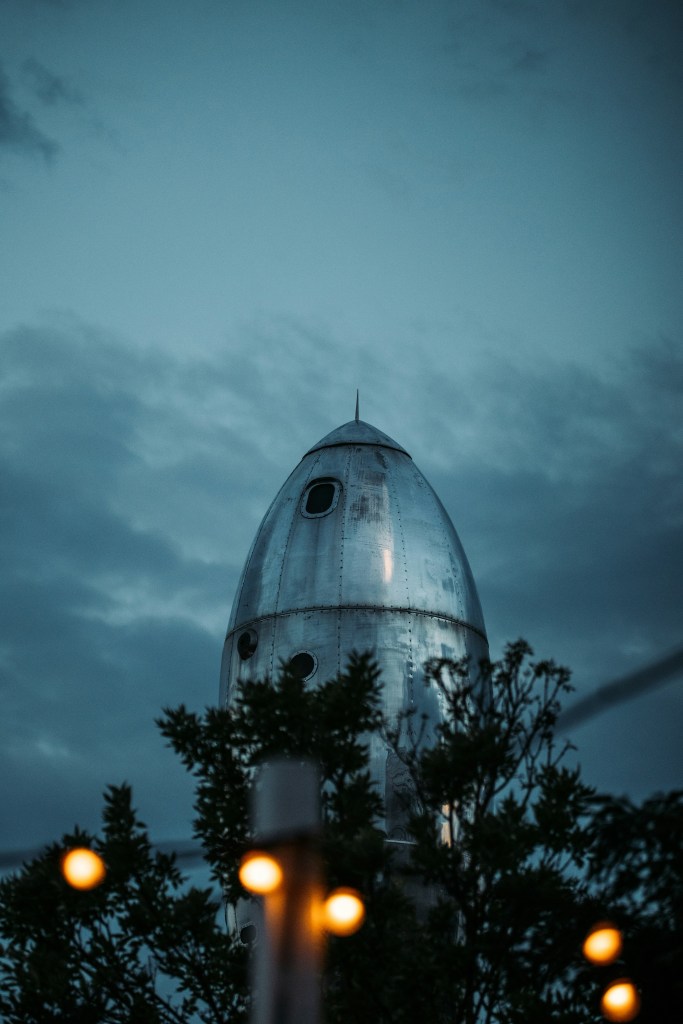
Photo from Jakob Rosen on Unsplash
Cultural Perspectives and the Documentary Spaceship Earth
A documentary titled “Spaceship Earth” (2020) offers a fresh and in-depth perspective on the Biosphere 2 experiment, shedding light on details that had previously gone largely unnoticed and inviting viewers to see this ambitious project from a more humanized angle. Wired describes the film as a narrative effort that successfully reframes public perception of Biosphere 2from what was once widely regarded as a scientific failure into a collective expression of optimism, proving just how much can be achieved when people unite under a shared vision: “[Spaceship Earth] repositions the experiment as a modest success, proof of how much optimism can achieve…” (Wired).
Meanwhile, Vanity Fair reveals a surprising and rarely discussed fact: the primary funding for this massive $200-million scientific facility actually came from a late-1960s counterculture theater groupa background far removed from the image of a conventional scientific laboratory: “The film highlights a late-’60s counterculture theater group… leading the $200 million scientific research facility Biosphere 2” (Vanity Fair).
Equally compelling, Vox notes that the documentary tells a story that is “strange and surprising, yet inspiring” about the Biospheriansa group of individuals dressed in futuristic jumpsuits who lived in complete isolation for two full years inside the sealed ecosystem. Through a combination of interviews, archival footage, and recordings of daily life inside the dome, the film blends elements of drama, scientific experimentation, and social reflection, giving audiences not only factual insights but also an immersive sense of the challenges, idealism, and hope that surrounded the project.
For those interested in engaging directly with the current programs and digital resources of Biosphere 2, the University Biosphere app (https://biosphere2.stqry.app/story/121656?share=ios) offers an accessible platform to learn more about its research and educational outreach.
References
- Alling, A., Van Thillo, M., Dempster, W., Nelson, M., Silverstone, S., & Allen, J. (2005). Lessons Learned from Biosphere 2 and Laboratory Biosphere Closed Systems Experiments for the Mars On Earth® Project. Biological Sciences in Space, 19(4), 250–260. https://doi.org/10.2187/bss.19.250
- Wired. (2020, May 12). Spaceship Earth and the Value of Utopian Thinking. WIRED. https://www.wired.com/story/spaceship-earth-utopianism
- Wolf, M. (2020, January 25). The Strange Tale of Biosphere 2 Gets a Fitting Showcase in Spaceship Earth. Vanity Fair. https://www.vanityfair.com/hollywood/2020/01/biosphere-2-movie-spaceship-earth-matt-wolf
- University of Arizona News. (2024, March 13). All-artist crew to emerge from simulated moon mission after six days. University of Arizona. https://news.arizona.edu/press-release/media-advisory-all-artist-crew-emerge-simulated-moon-mission-after-six-days
- University of Arizona News. (2025, February 11). Becoming a multiplanetary species: Crew completes first mission in pressurized habitat at Biosphere 2. University of Arizona. https://news.arizona.edu/node/24592
- YouTube. (2022). How the Netherlands Feeds the World [Video]. YouTube. https://www.youtube.com/watch?v=b_TKuYpL1ks
- https://biosphere2.stqry.app/story/121656?share=ios
 Gratify Gravity