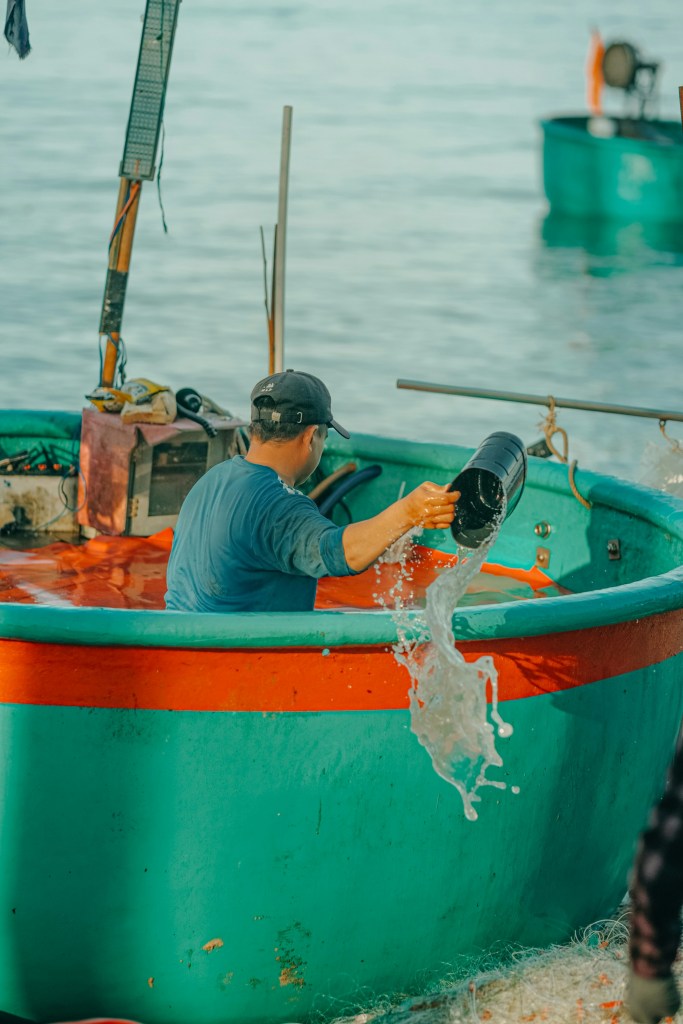
Photo from Pew Nguyen on Unsplash
On countless dinner tables, squid appears as a delicacy: fried until crisp, stir-fried with spices, or served elegantly as sushi. Yet behind this seemingly simple dish lies a dark story rarely told. The squid we consume may come from distant waters marked by human sufferingmigrant workers trapped on distant-water fishing vessels, often without rights, without protection, and without a voice. These invisible chains are not only about seafood but also about human beings bound to forced labor in the middle of the ocean.
A recent report by the Environmental Justice Foundation (EJF) revealed harrowing practices aboard China’s squid fishing fleet. Workers, many of them migrants from developing Asian countries, reported being forced to work up to 20 hours a day, subsisting on spoiled food, with wages withheld and even suffering physical abuse (The Washington Post, 2025). In EJF’s survey, 95% of crew members stated that they had witnessed or experienced illegal, unreported, and unregulated (IUU) fishing, while 85% described their living and working conditions as inhumane (Maritime Fairtrade, 2025).
Further investigation by The Guardian (2025) found evidence of North Korean forced labor in some fleets. This not only raises human rights concerns but may also violate long-standing international sanctions. With personal documents confiscated, communication cut off, and vessels operating far beyond the reach of law, workers are effectively trapped at sea, reduced to modern-day captives.
These abuses are not isolated incidents. China’s squid fleet is among the largest in the world, operating from South America to West Africa. The squid they catch enters the global supply chainprocessed, exported, and eventually served in restaurants and supermarkets worldwide. This means that the global seafood trade is directly connected to chains of hidden human suffering on the high seas. We may never see the faces of these workers, but our consumption choices can reinforce the very system that exploits them.
The issue exposes the weakness of global ocean governance. The high seas are often described as “lawless waters,” where vessels can shift flags, evade port inspections, and continue illegal practices without consequences. Countries of nationals often lack the capacity to protect their citizens, while consumer nations rarely trace the source of their seafood imports. As a result, forced labor persists in a legal gray zone across international waters.
Still, this problem is not without solutions. EJF has called for greater transparency in the seafood supply chain, including mandatory traceability from catch to consumer. Consumers, supermarkets, and restaurants also have crucial roles to play by demanding seafood free from forced labor and IUU fishing. At the global level, strengthening international agreements against forced labor at sea and tightening regulations on seafood trade are urgent steps.
In the end, the question we must ask is simple yet profound: when we enjoy squid on our plates, are we willing to ignore the invisible chains of human suffering that brought it there? Seafood should symbolize the richness of nature and culinary culturenot the persistence of modern slavery hidden far from public view. Exposing these invisible chains is the first step toward ensuring that the ocean remains a source of life, not a source of suffering.
References (APA 7)
Environmental Justice Foundation. (2025). New report reveals human rights abuses and illegal fishing on China’s distant-water fleet. Maritime Fairtrade. https://maritimefairtrade.org/new-report-reveals-human-rights-abuses-illegal-fishing-on-chinas-distant-water-fleet/
The Guardian. (2025, February 25). Chinese fishing fleets using North Korean forced labour in potential breach of sanctions, report claims. The Guardian. https://www.theguardian.com/world/2025/feb/25/chinese-fishing-fleets-using-north-korean-forced-labour-in-potential-breach-of-sanctions-report-claims
The Washington Post. (2025, September 17). Chinese squid fishing abuses revealed. The Washington Post. https://www.washingtonpost.com/world/2025/09/17/chinese-squid-fishing-abuses/
 Gratify Gravity